Should you need urgent health advice please contact your GP or call NHS 111. In an emergency please visit A&E or call 999

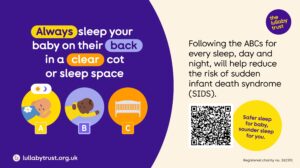
Safe sleep environment
- Always place your baby on their back for every sleep to significantly reduce the risk of sudden infant death syndrome (SIDS).
- Keep your baby’s cot, crib or moses basket clear of items like bumpers, soft toys, loose sheets and duvets. Use a firm, flat, waterproof mattress which is in good, clean condition.
- Put your baby to sleep in your room with you at night for the first 6 months. For daytime sleeps, ensure that your baby is in the same room as you for the first 6 months.
- Place your baby with their feet at the bottom of the cot to prevent them from slipping under blankets.
- Keep the room temperature between 16-20 degrees celsius to avoid them overheating, which is a SIDS risk factor.
- Never fall asleep with your baby on a sofa or armchair, as this significantly increases SIDS risk.
- Do not use pillows, soft bedding, cot bumpers, or pods/nests.
- Avoid letting babies sleep in car seats, prams, or strollers for long periods, as these are not designed for routine, long-term sleep.
Sources:
Safer sleep overview | The Lullaby Trust
Sudden infant death syndrome (SIDS) – NHS
Preventing falls
Injuries can happen when parents and other carers underestimate what their baby can do. Babies develop new skills very quickly and you might not be prepared for what they can do. For example, your baby could roll off your changing table in a split second when your back is turned.
Because a baby’s head is proportionately larger than adults, they have a different centre of gravity meaning they are far more likely to impact their head during a fall.
- Bring your baby with you if you need to get something or answer the door or phone.
- To prevent falls, change your baby’s nappy on the floor and never leave them on a raised surface such as a changing table or a sofa.
- Before babies are mobile, they can be injured when the person carrying them falls so take care when carrying your baby up and down stairs.
- Install stair gates correctly and keep them closed. Use stair gates at top and bottom of stairs. Use them at other areas that pose a trip hazard, like steps at doorways or changes in floor level. Keep steps and staircases clear.
- Strap babies into all seats, including feeding chairs, car seats, buggies, prams and bouncers. Only use equipment and sitting devices with a 5-way safety harness.
- Baby walkers are not recommended as they allow children to achieve movement faster than expected and can contribute to a fall if the walker topples over. Walkers also allow children access to things they might not otherwise be able to reach, such as poisons or hot drinks.
Sources:
How to prevent falls in children | Falls safety tips for families
RoSPA- Keeping Kids Safe | Preventing falls and injuries

Strangulation and suffocation
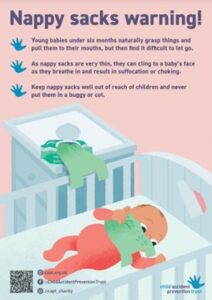
Young babies under six months naturally grasp things and pull them to their mouths but then find it difficult to let go.
- Nappy sacks are very thin, so can easily cling to the baby’s face as they breathe in so always keep nappy sacks away from your baby and do not store them in a cot or a pram.
- Because they cannot push bedding away from their faces, duvets or quilts should not be used with babies under 12 months – use breathable blankets or a lightweight sleeping bag which is the right size to stop the baby wriggling down into it.
- Beware of blind cords, the loop in blind cords can go around your baby’s neck, leading to strangulation. It takes as little as 18 seconds for a child to become strangled by a blind cord.
- Ensure cords and chains are pulled taut by fitting blind cord safety devices such as cleats.
- Do not place your child’s cot, bed, highchair or playpen near a window or door blind. ·
Sources:
Suffocation | Child Accident Prevention Trust
How to prevent choking, suffocation and strangulation | UNICEF Parenting
Burns and scalds
A baby’s skin is 15 times thinner than an adult’s and will burn or scald much more easily.
- Do not drink hot drinks when holding your baby as a hot drink can scald up to 20 minutes after it has been made.
Preventing choking
- If you are feeding your baby from a bottle, always hold the bottle rather than propping it into your baby’s mouth as this could cause your baby to choke.
- Never add any food such as rice or rusks into your baby’s bottle unless you have been advised to by a medical professional.
- Never tie strings or ribbons to a baby’s dummy as these could come loose and cause your baby to choke.
- Jewellery, including teething beads, can be dangerous around your baby as they can break apart and become a choking hazard
Babies explore the world around them by putting things in their mouth so it is important to make sure small objects are kept away from them to avoid choking. This includes things like marbles, batteries, magnets, coins and small toys like lego.
This is especially important in unfamiliar places where small objects could be within your baby’s reach. It can be useful to get down onto the floor to see things from your baby’s view to identify any potential choking hazards.
In addition to being a choking hazard, button batteries can cause significant harm to your baby if swallowed. Button batteries can react with saliva, creating caustic soda which can burn through your baby’s digestive system, leading to serious injury or even death.
If swallowed, magnets can also cause serious injury due to the risk of the magnets ripping through the digestive tract and cutting off the blood supply.
Sources:
Magnets safety | Top tips to keep children safe
Why are button batteries so dangerous? | Learn the risks
RoSPA- Keeping Kids Safe | Choking prevention and first aid

Sussex Community is responsible for the writing, publishing and updating of the content on this page.